


Attorney Joe Coimbra
California Sex Offender Registration Termination Attorney
Approximately Thirty Years in the Legal Industry
Attorney Joseph “Joe” Coimbra has spent approximately thirty years in the legal industry and devotes virtually the entirety of his practice to advocating for and restoring the freedom, dignity and humanity of persons previously convicted of registrable sex crimes as well as aggressively challenging and fighting false accusations levied against persons facing the prospect of imprisonment and lifetime sex offender registration.
The post-conviction relief he and Second Chances Law Group affirmatively (as opposed to defensively) file and carry forward on behalf of California registered sex offenders spans virtually
every manner of restoring the rights, in whole or in part, of persons whose criminal record has saddled them with long-term and painful repercussions—expungements, felony-to-misdemeanor
reductions, removals from the Megan’s Law Website, challenges to the original criminal convictions, petitions to seal records of arrest and, of course, petitions to terminate the duty to register as a sex offender. Unlike other lawyers who divide their time between criminal defense and occasionally filing petitions to terminate sex offender registration, Attorney Joseph Coimbra’s representation always moves in one direction—sticking up for persons caught in the cross-hairs of the government’s wrath regarding sex crimes regardless of the stage in which his clients find themselves: the inception, meaning the investigatory stage; a filed sex crimes criminal complaint; already convicted through past counsel; already in the process of having filed a petition but facing prosecutorial opposition; and everything in between.
California’s registration requirement attaches by conviction and by residence, and Mr. Coimbra’s termination practice covers every configuration of the two. He represents persons convicted in
California who continue to live in California. He represents persons convicted in California who have since relocated to another state (and who are required to register in that out-of-state jurisdiction) but whose registration requirement in California would resume upon return UNTIL they are successfully petitioned off the registry altogether (and who, depending on the out-of-state jurisdiction, may experience the end of their registration obligation there also). He represents persons convicted in another state, in federal court or by court-martial who, by establishing residence in California, became subject to California’s registration law and thereby acquired the right to petition for termination under the tiered registry statute. He has secured termination orders for clients in all the aforementioned categories. His successful deregistration work also predates the tiered registry itself. Mr. Coimbra has litigated petitions throughout California that culminated in the restoration of his clients’ rights as well as their privacy and protection from further public exposure as convicted registered sex offenders (i.e., removal of the “Scarlet Letter” of Megan’s Law profiling). The McMartin preschool trial of the 1980s, and the historical “witch hunts” that followed it, drew Mr. Coimbra to this work. Awareness campaigns such as the #MeToo movement, perhaps well intentioned at the outset, later degenerated at least in part into baseless accusations against innocent people. Mr. Coimbra built his practice around representing persons who were falsely accused of sex crimes, persons whose supposed misdeeds were exaggerated or confabulated by accusers acting out of ill will or personal animosity, and persons who were convicted years or
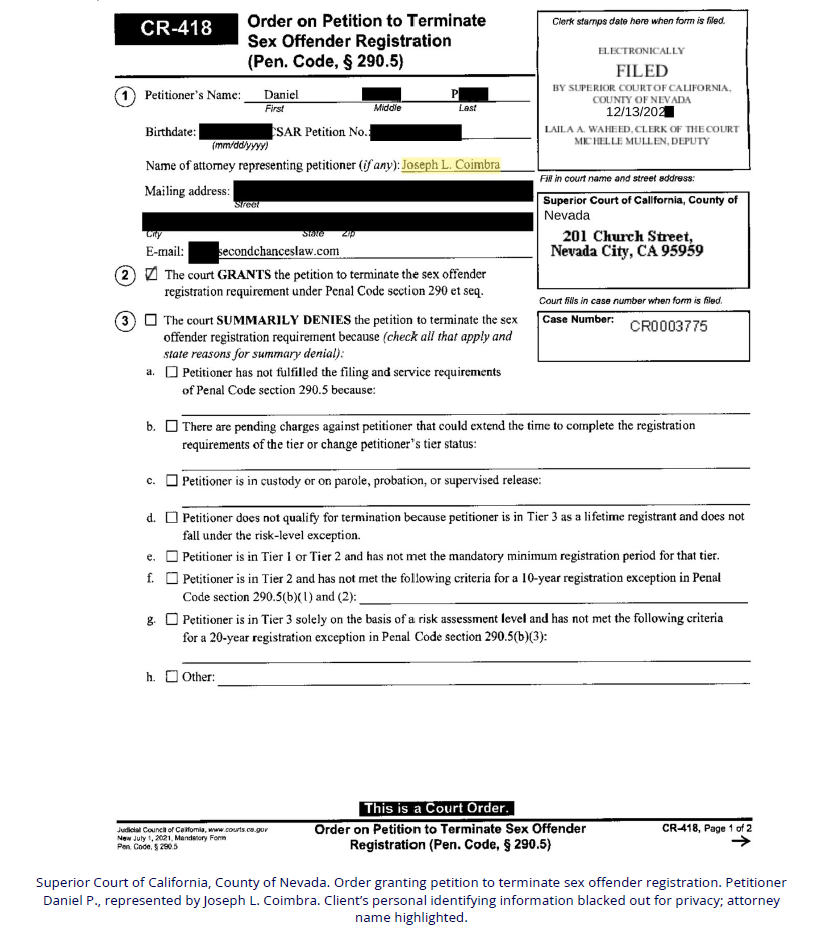
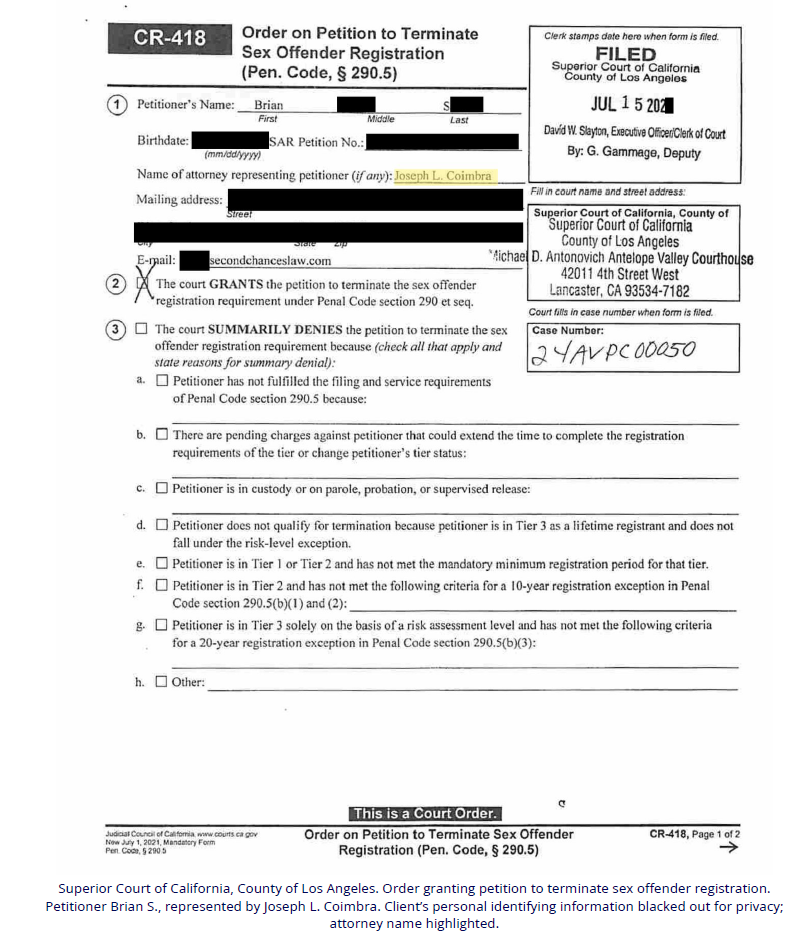
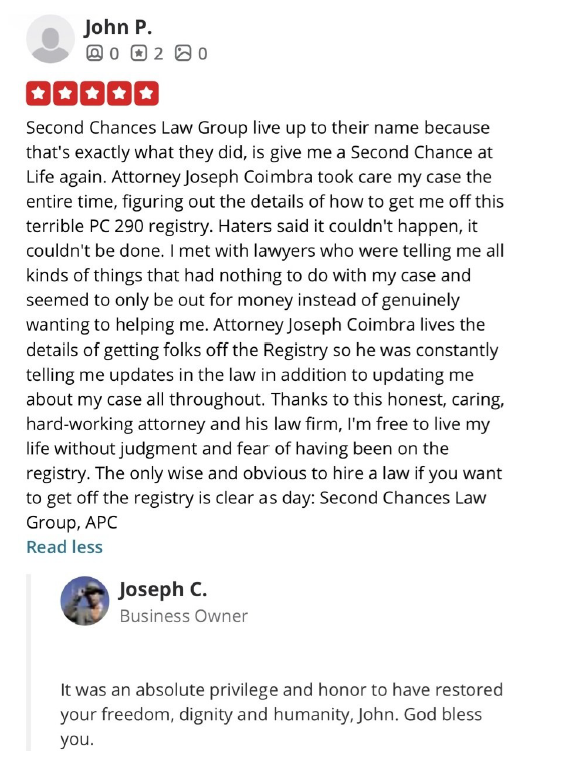
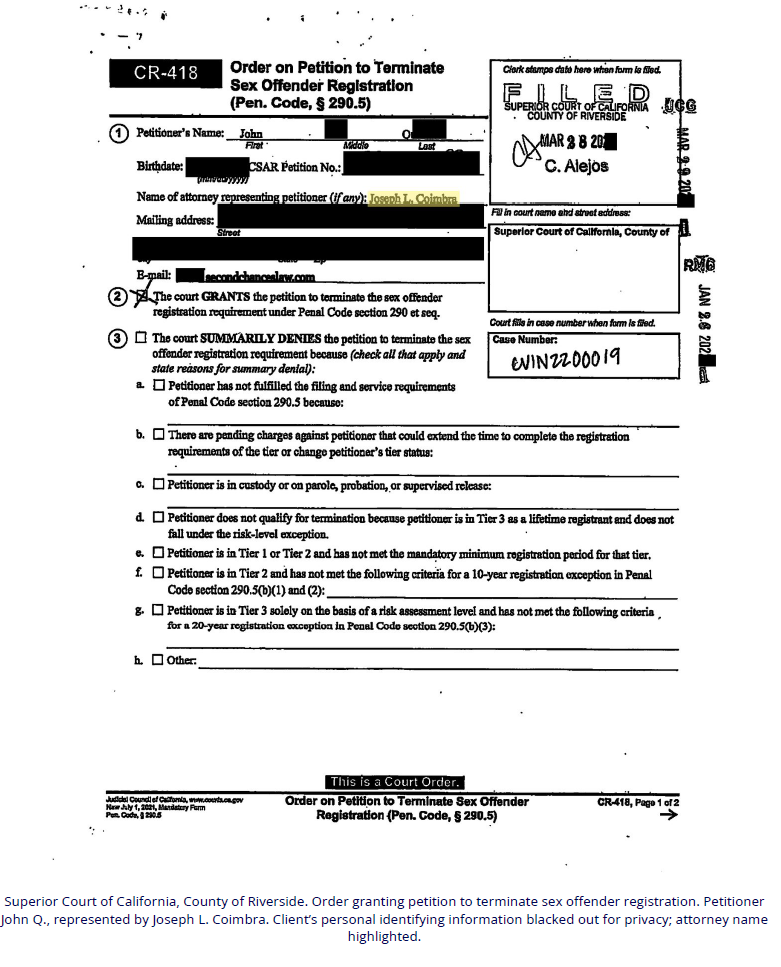
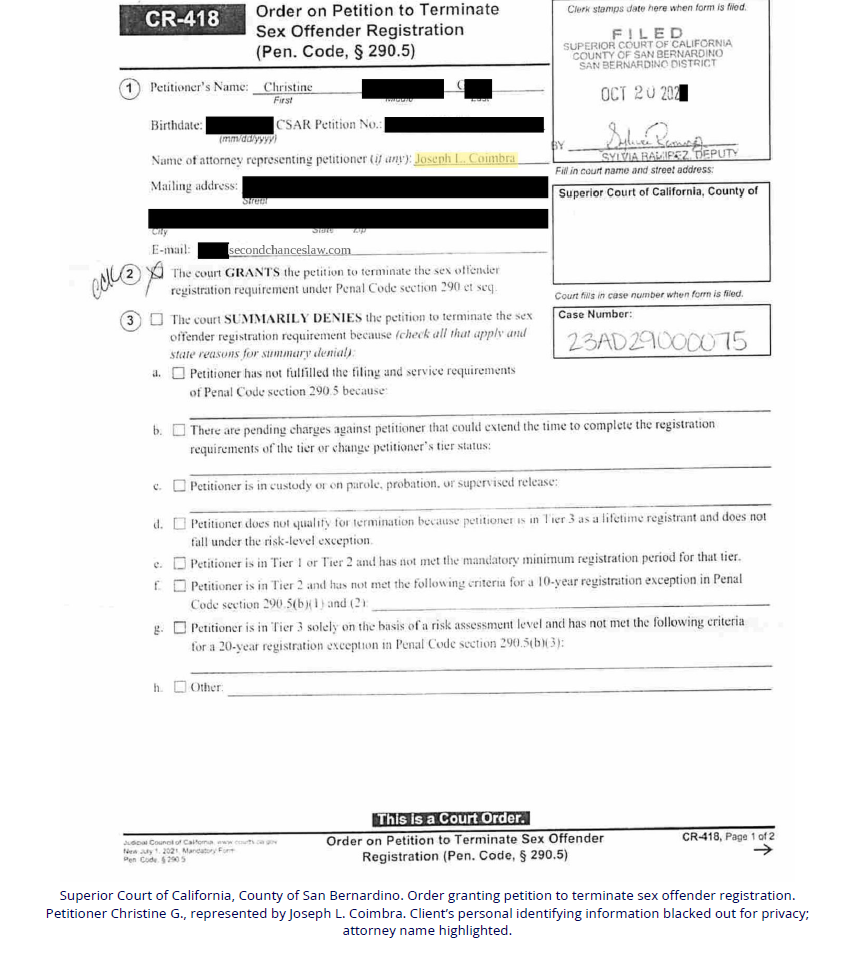
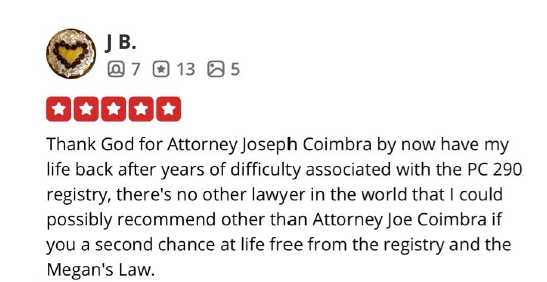
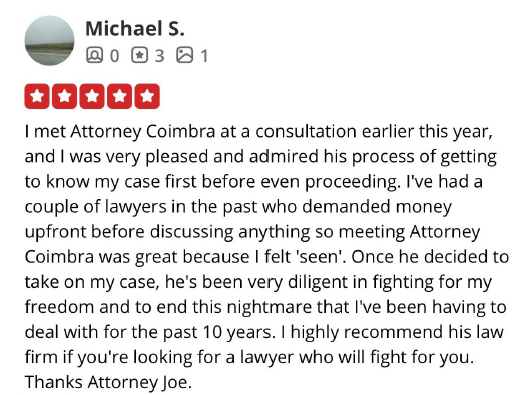
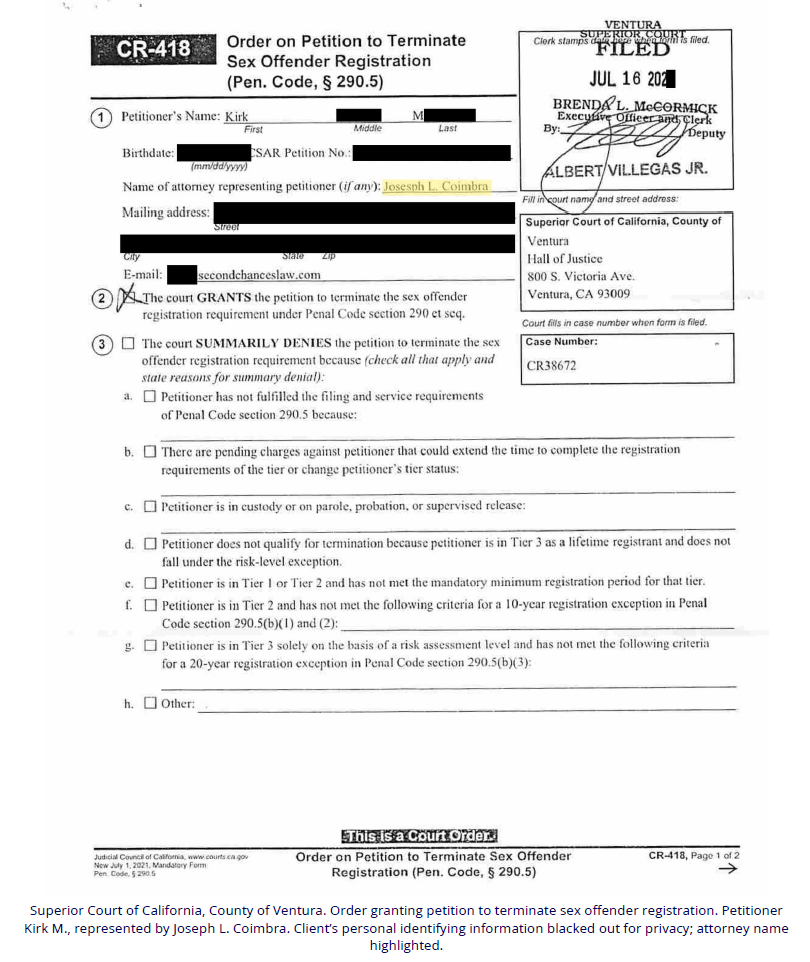
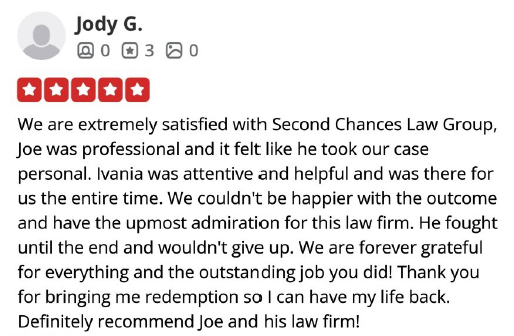
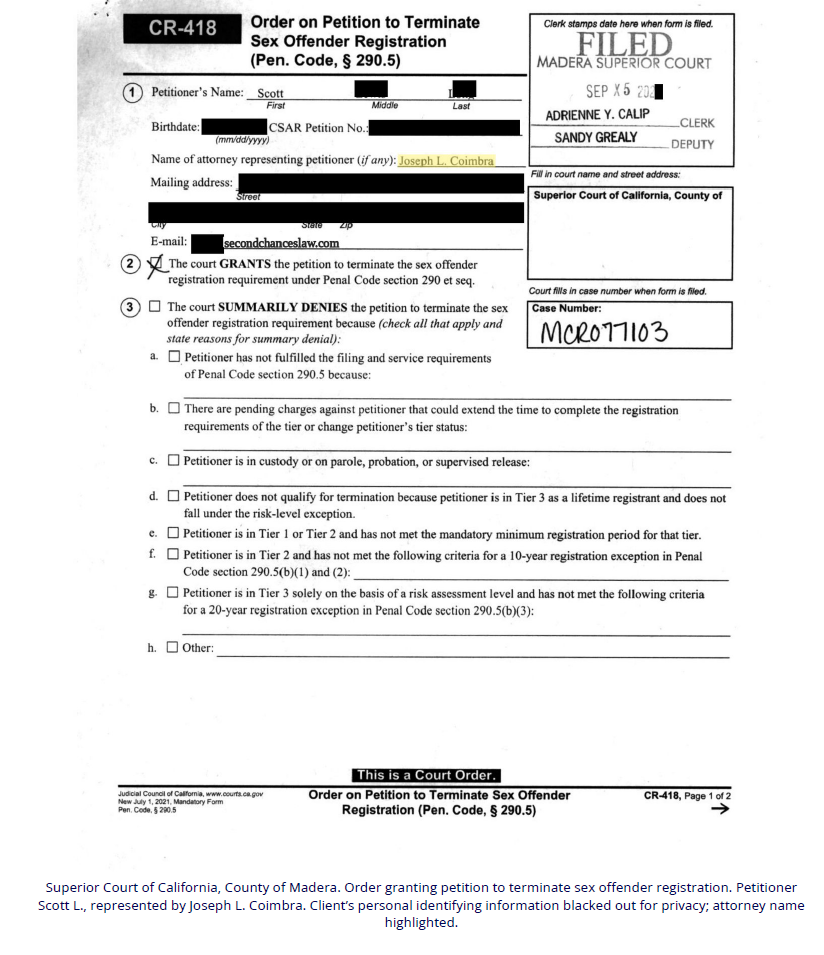
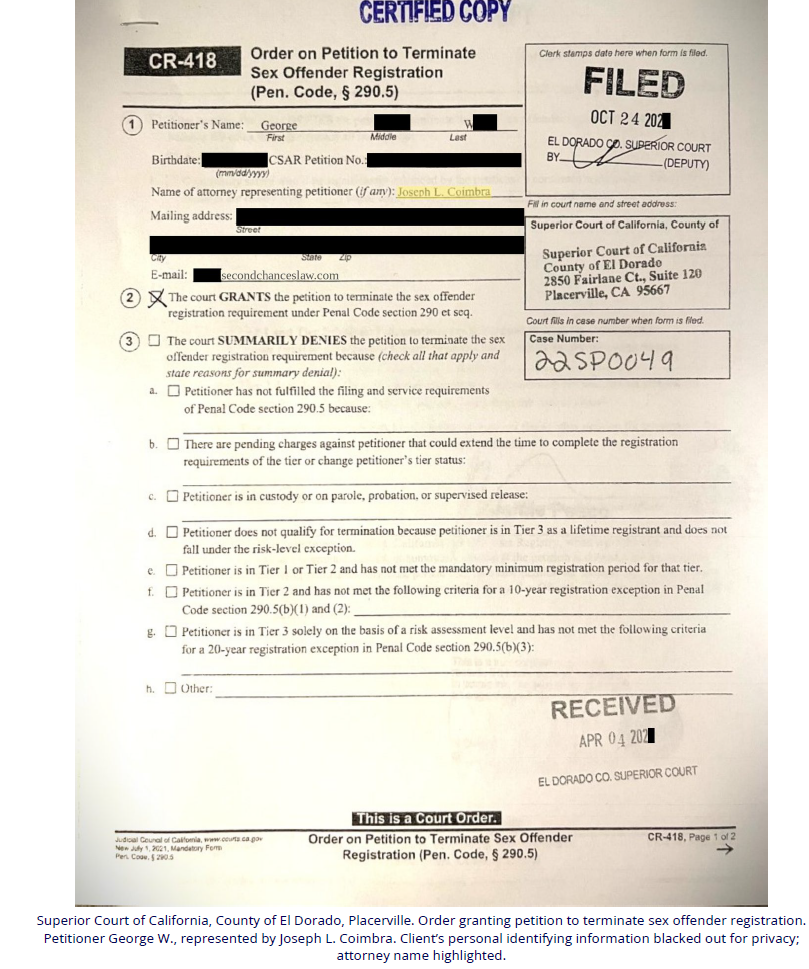
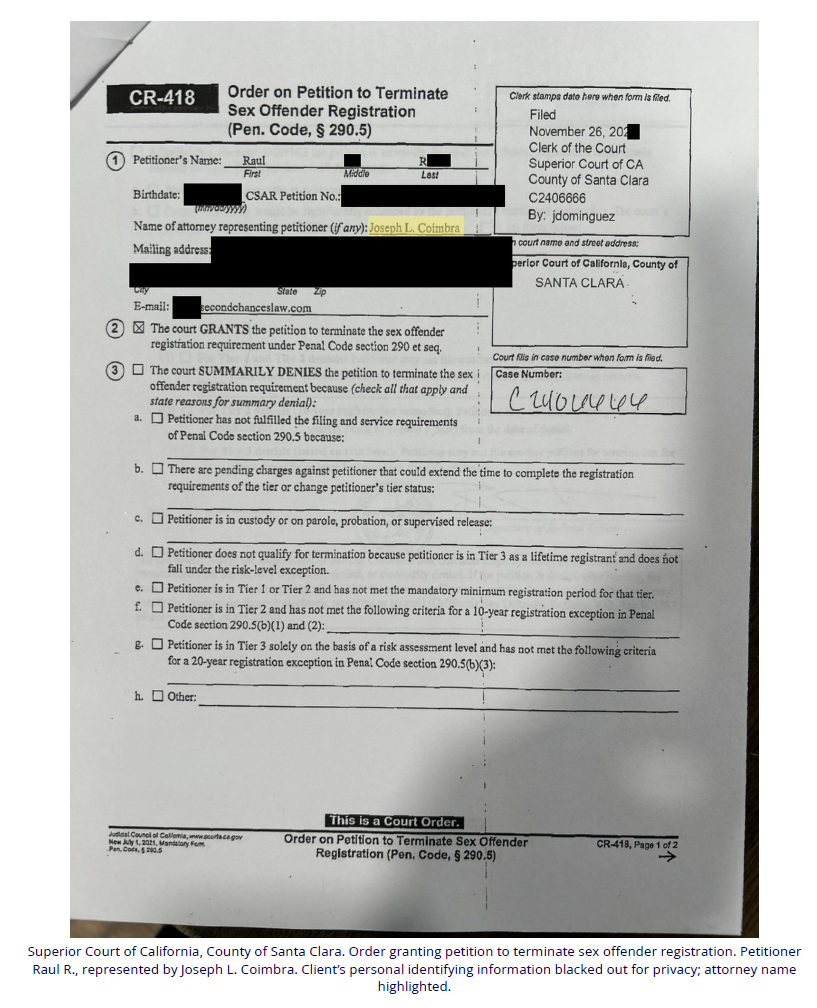
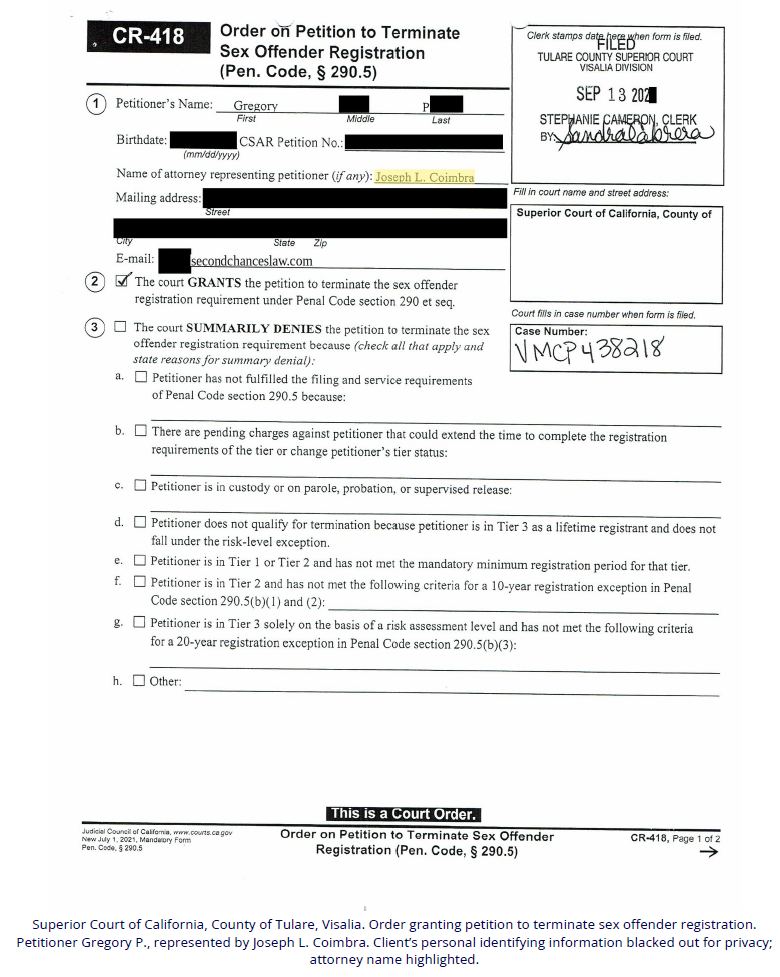
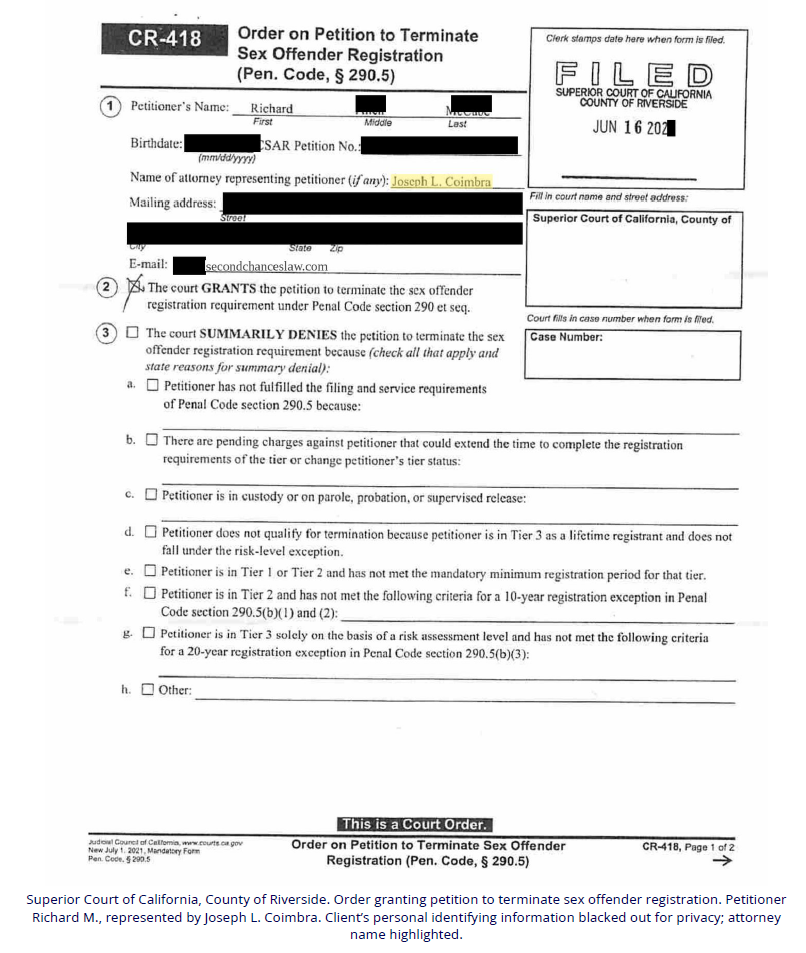
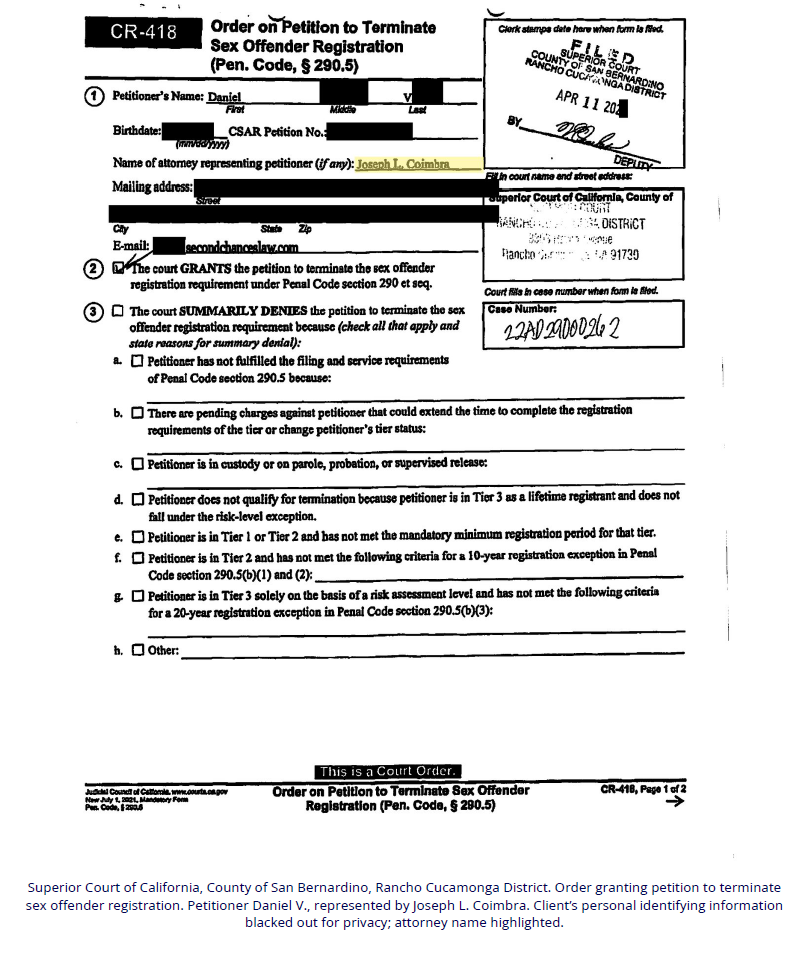
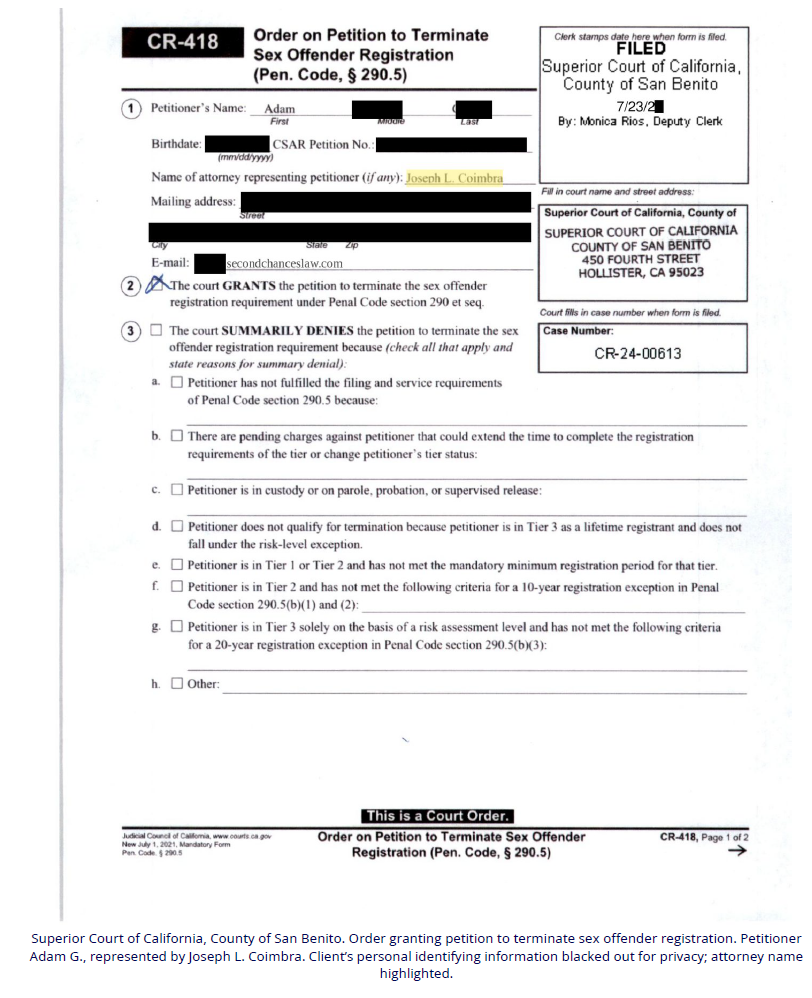
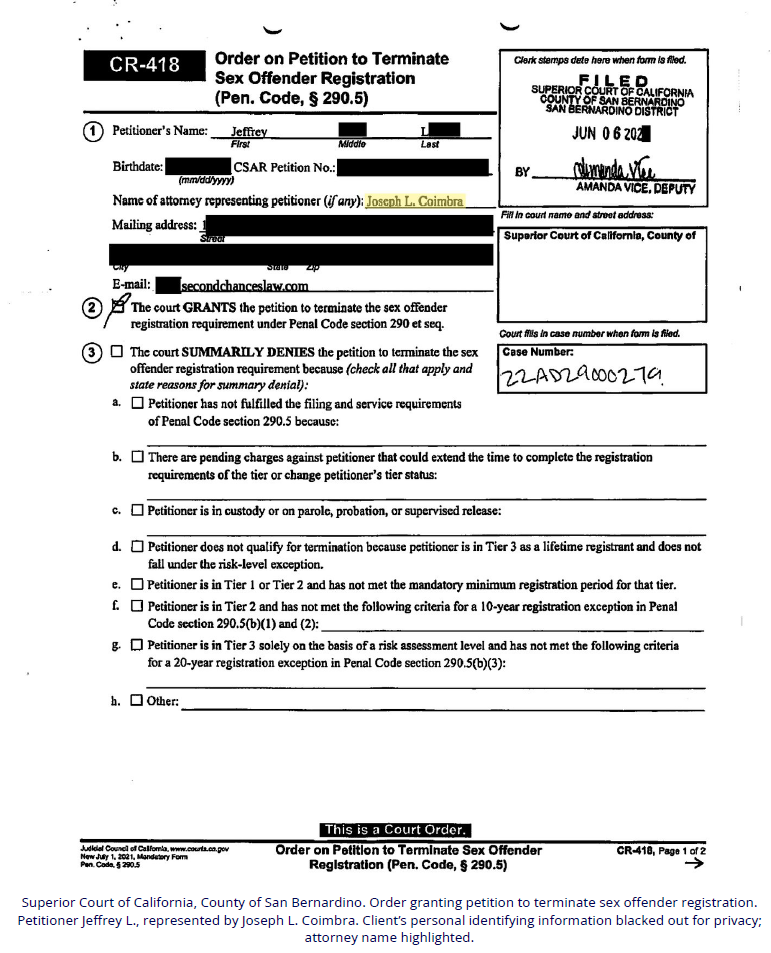
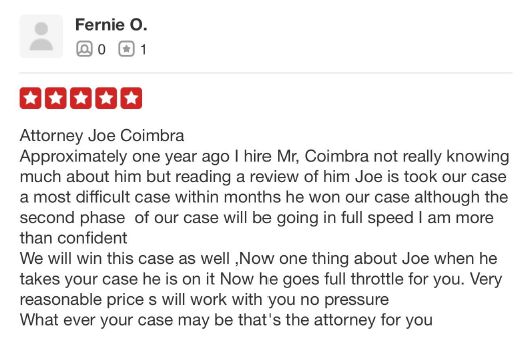
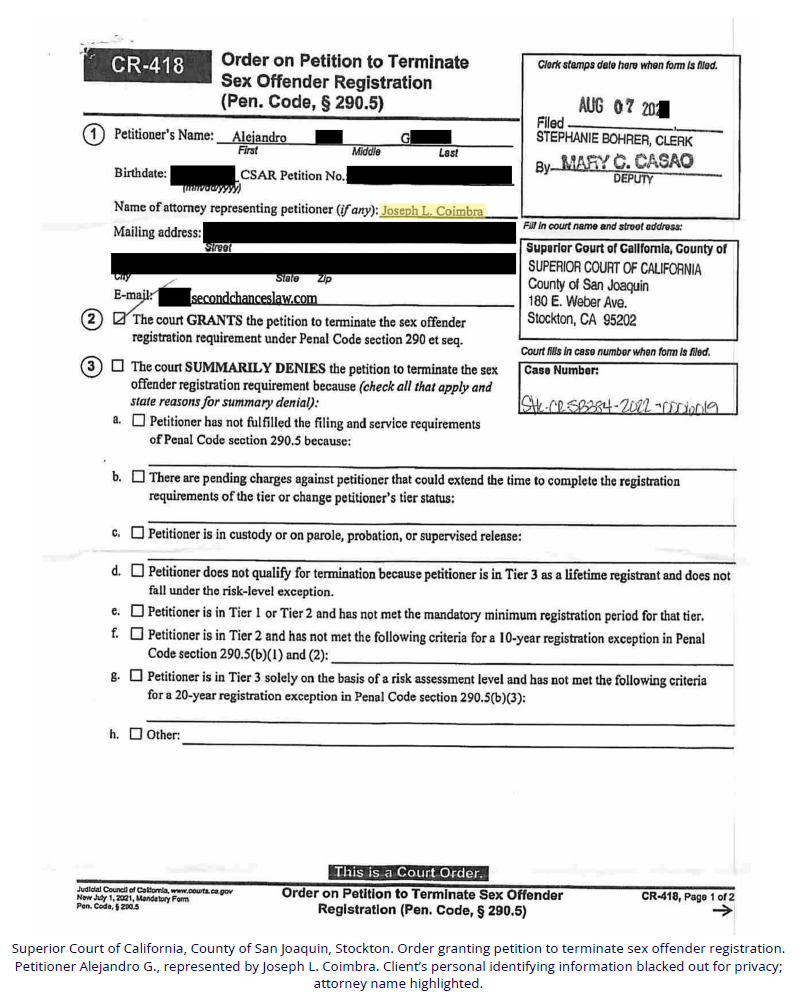
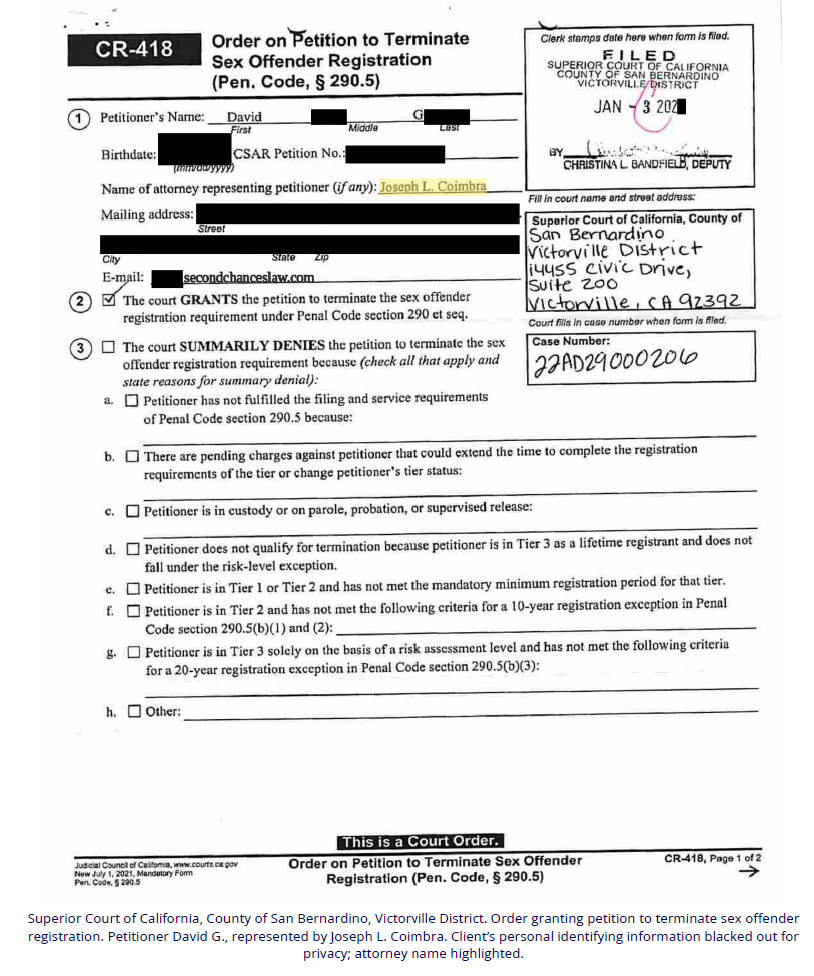
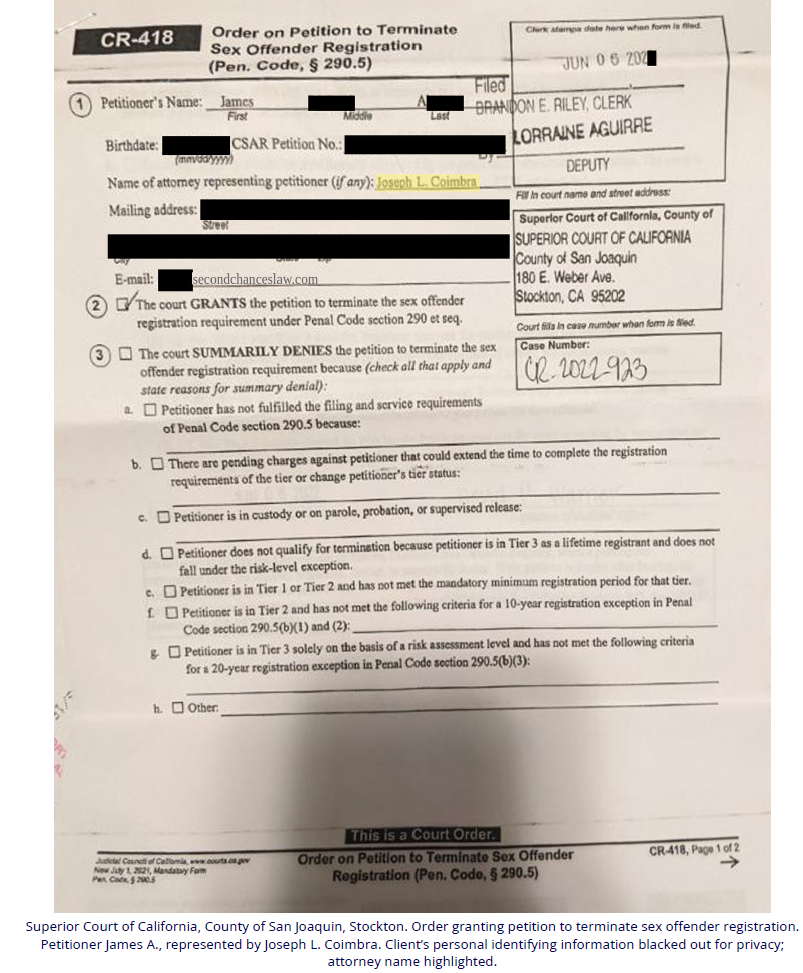
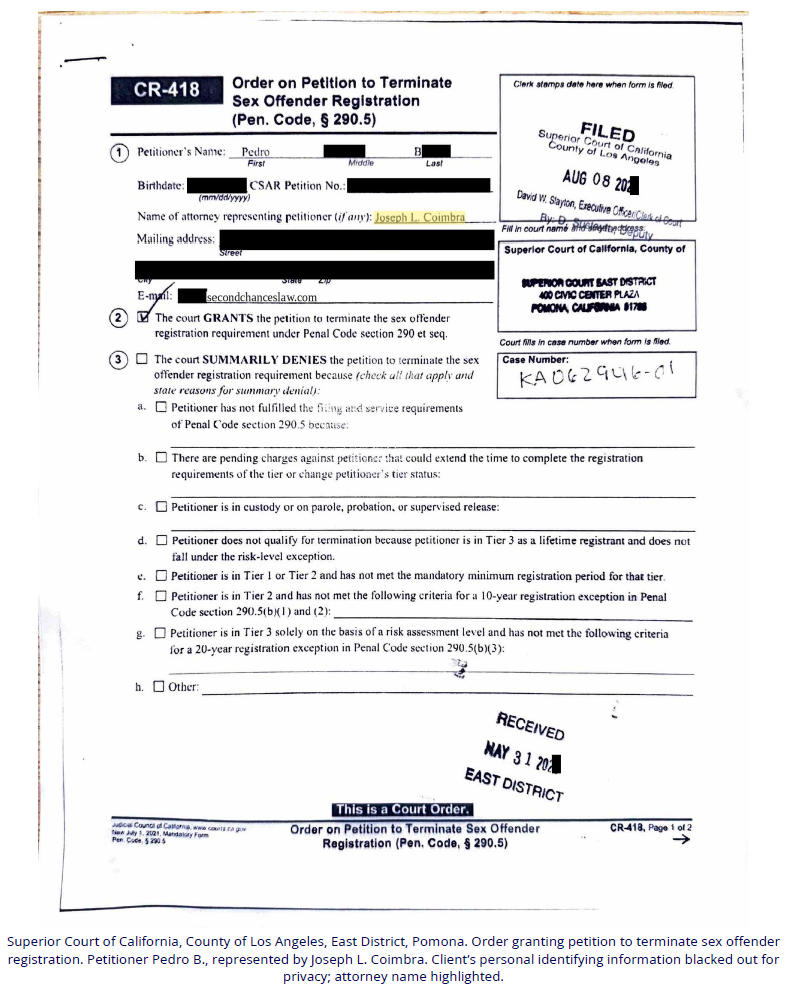
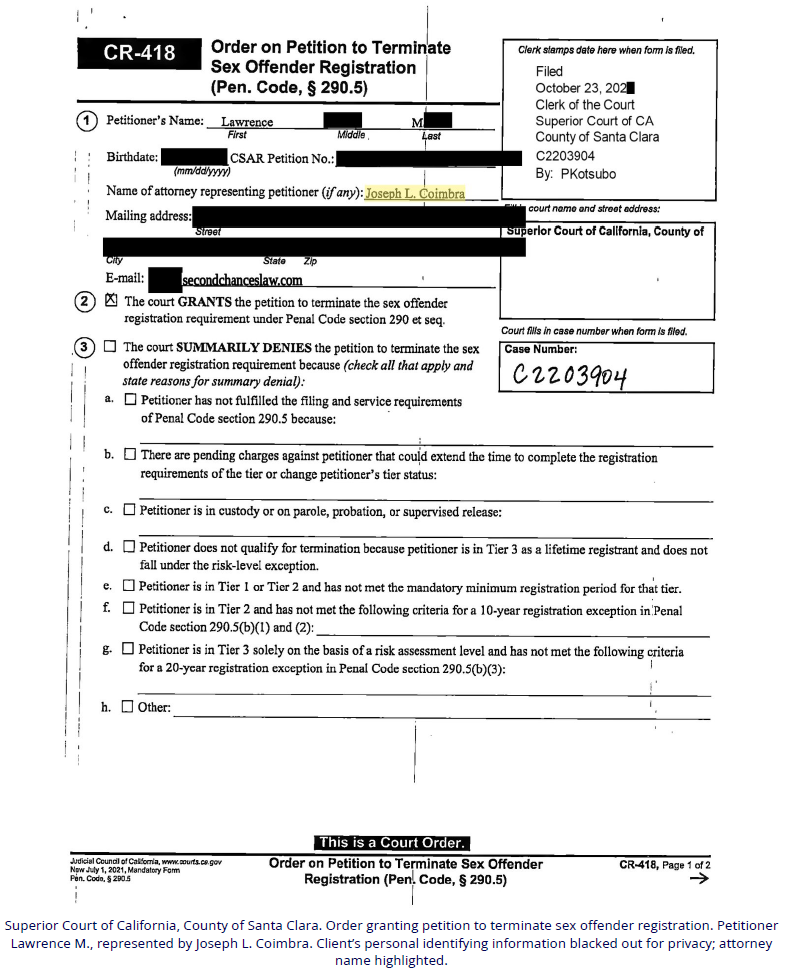
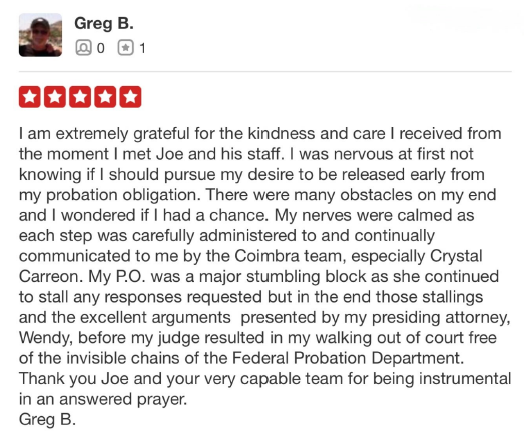
decades ago and have long since repaid their debt to society. The five-star client reviews and the court orders presented on this page are a sampling. They are hardly exhaustive of the firm’s successful petitions removing clients from the registry, let alone exhaustive of its abundant victories across the full range of post-conviction remedies. Every court order that appears on this page is an actual CR-418 Order on Petition to Terminate Sex Offender Registration, signed by a judge of a California superior court and bearing that court’s filing stamp, granting a petition that Mr. Coimbra filed and argued. Each client’s name, birthdate, address and registration number have been blacked out to protect that client’s privacy. The court, the case number, the filing stamp and the judge’s signature appear exactly as they do on the original.

If you are a California Registrant and want your registration obligation ended, or you are facing a criminal matter of any kind, call (626) 205-3794. Second Chances Law Group offers free initial consultations, and weekend appointments are often available.
How a Section 290.5 Petition Works
For decades California imposed registration for life on nearly everyone convicted of a registrable offense, without regard to the seriousness of the offense or the decades of blameless living that followed it. The tiered registry changed that. A Registrant who has completed the minimum registration period for his or her tier may now petition the superior court in the county of conviction for termination under Penal Code section 290.5. The district attorney may request a hearing and ask the court to deny termination on the ground that community safety would be significantly enhanced by the petitioner’s continued registration. Prosecutors lodge that objection in county after county, and they lodge it with particular frequency in cases where the offense is twenty, thirty or forty years old and the petitioner has raised a family, held a job and never again been in trouble. When the court grants the petition, it signs a CR-418 order directing the Department of Justice to terminate the Registrant’s duty to register, and the sentence that was supposed to last for life ends that day.
Overcoming the Prosecutor’s Community-Safety Objection
The community-safety objection is where most petitions are won or lost, and it is where Mr. Coimbra has built his reputation. He has successfully represented Registrants throughout California against those objections, and he treats every contested petition as full motion practice from the day it is filed. He has authored substantial written motion work on the text of section 290.5, the legislative history of the tiered registry, the published appellate decisions construing the statute, and each of the factors the court must weigh: the nature and facts of the registrable offense, the petitioner’s criminal and relevant noncriminal conduct before and after conviction, the length of time without reoffense, the petitioner’s treatment history, and the petitioner’s current risk of reoffense as measured by the state’s approved risk-assessment instruments. He builds each case from the complete court record, and he walks into the hearing holding an encyclopedic command of every statutory and case authority the court or the People might raise. A prosecutor who files a community-safety objection against one of Mr. Coimbra’s petitions should expect to be answered, point by point, with the statute, the cases and the record.

Granted Orders From Across the State
Mr. Coimbra has won termination orders in superior courts throughout the state. The orders below were signed by judges of the superior courts of Los Angeles County, including the Pasadena and
Pomona courthouses; San Bernardino County, including the San Bernardino, Rancho Cucamonga and Victorville courthouses; Riverside County; Santa Clara County; San Joaquin County at Stockton; Ventura County; San Diego County; Stanislaus County; Tulare County at Visalia; Madera County; El Dorado County at Placerville; Plumas County; Nevada County; and San Benito County. Behind each order stands a person who registered every year, in some cases for most of his or her adult life, and who no longer has to.
















After the Order Is Signed
A signed CR-418 ends the duty to register, and Mr. Coimbra’s office finishes the job. The firm delivers the order to the client’s annual registration office so that the client never has to walk back into that office again, and to the California Department of Justice so that the client’s Megan’s Law profile comes down. The firm then notifies the United States Department of State so that the International Megan’s Law unique identifier is removed from the client’s passport, and it pursues removal of the client’s information from as many privately owned and commercial websites as possible.
In Attorney Coimbra’s Words
“As a society, we cannot claim to live in a representative democracy if just about anybody can be targeted by an allegation of sexual impropriety and then be convicted on little more than a weak
foundation of a verbal denunciation lacking corroborating physical, forensic or other objectively verifiable evidence. This is especially problematic given how high the stakes are: persons convicted of sex crimes are effectively relegated to the status of a moral and social leper as well as lifelong criminal outcast years if not decades after they’ve repaid their debt to society. “I’ve devoted my professional life to preventing such horrific repercussions for accused persons, and to reversing course for persons who were previously convicted of a sex crime, whether because of inadequate counsel by their former lawyer or for any other reason.”
Defending Sex Crime Charges and Other Criminal Cases
The same single-mindedness governs Mr. Coimbra’s trial and motion practice. An accusation of a sex crime arrives with a presumption of guilt in the public mind, a prosecutor who has already chosen a side, and a penalty that outlasts any prison term. Mr. Coimbra concentrates on those accusations and on serious felony charges where sustained pretrial motion work can end the case before a jury is ever seated. His record includes outright dismissals of sex crime charges and of other serious felonies, including strike cases.

How Attorney Coimbra Works With Clients
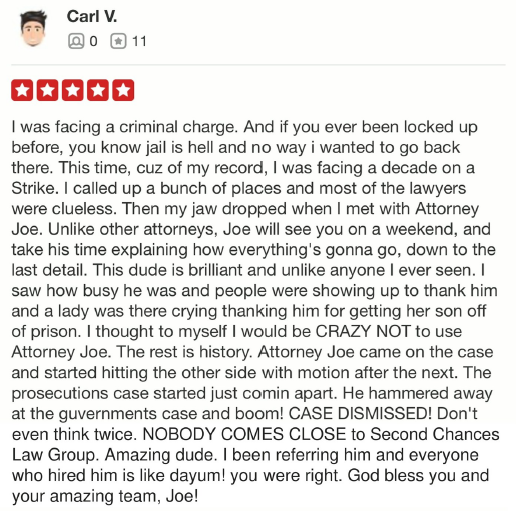
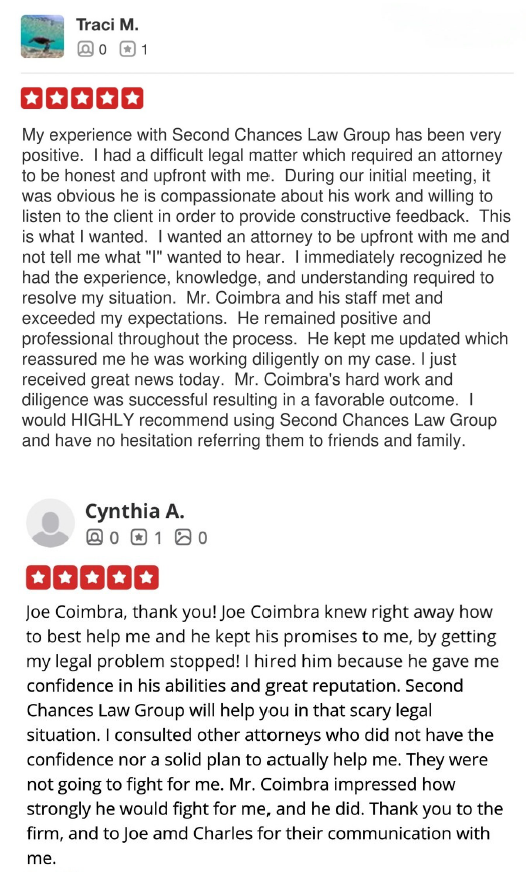
A prospective client receives a straight assessment before paying anything. Mr. Coimbra meets with each client personally, learns the case before proposing a course of action, and says plainly whether the petition or the defense is worth pursuing. Clients describe honesty at the first meeting, a clear plan, and steady communication from Mr. Coimbra and his staff through the end of the case. Fellow lawyers refer their own matters to him.


He has earned certification in the ongoing legal education subject matters:
- Defending Sex Crimes
- Common Issues in Wrongful Convictions with the Innocence Project
- Scientific Evidence
- Cell Phone Forensics
- Consumer Electronics and the IoT: Digital Evidence
- Rule 35 Mental Exams
- Forensic Toxicology
- Latent Fingerprints
- Hearsay Evidence
- Direct and Cross Examination
- Jury Selection
- Bias in the Courtroom
- If You Have a Brain, You Have Bias (Implicit Bias)
- Adam Walsh Act: Family-Based Immigration Petitions
- Realignment and Sentencing Structure
- The Intersection of the Attorney-Client Privilege, the Work Product Doctrine, and the Professional
- Obligation of Confidentiality
- Conflicts and Confidentiality
- Performance Skills for Trial Attorneys
- Leveraging Technology to Win in Court
If you are a California Registrant who may be eligible to petition for termination, or you or a family member is facing a sex crime allegation or any other criminal charge, let us put approximately thirty years of experience to use for you. Call Second Chances Law Group at (626) 205-3794 for a complimentary case evaluation today.
Disclaimer: Nothing herein nor in any of our materials, regardless of their format, is ever intended to be construed as legal advice, and we have always and shall forever disclaim any and all promises, guarantees or assurances, whether implicit or explicit. We offer complimentary extended case evaluations to arrive at certain non-promissory conclusions, specifically, to determine your eligibility, to determine eligibility specific to particular remedies, and other opinions, but at no time have we ever nor will we ever make assurances, promises or guarantees of any kind regarding outcomes.